

Southeast Queensland Horticultural Best Management Practice Incentive Program (SEQ Hort BMP)
Fostering innovation and practice change across Southeast Queensland horticulture for the benefit of farm productivity, profitability, and stewardship of local waterways that lead to Moreton Bay.





Learn more about the project
-
The SEQ Hort BMP Incentive Program works with growers across the region to support the adoption of practices that improve water quality of local waterways as well as enhance farm productivity and profitability.
Achieving these outcomes means improving:
soil management and soil health
erosion and sediment control
nutrient management and nutrient-use efficiency
pest management and pesticide-use efficiency
We provide practical guidance and support to empower growers to adopt practices most suited to their farm through:
one-on-one consultation with a QFVG SEQ Hort BMP team member
capacity building through organised events like field walks, workshops, and grower meetings
connecting growers to relevant technical expertise and products
sharing of research, data, and insights by developing resources including articles, case studies and videos
financial support through incentive grants to aid practice change (read more about this below)
-
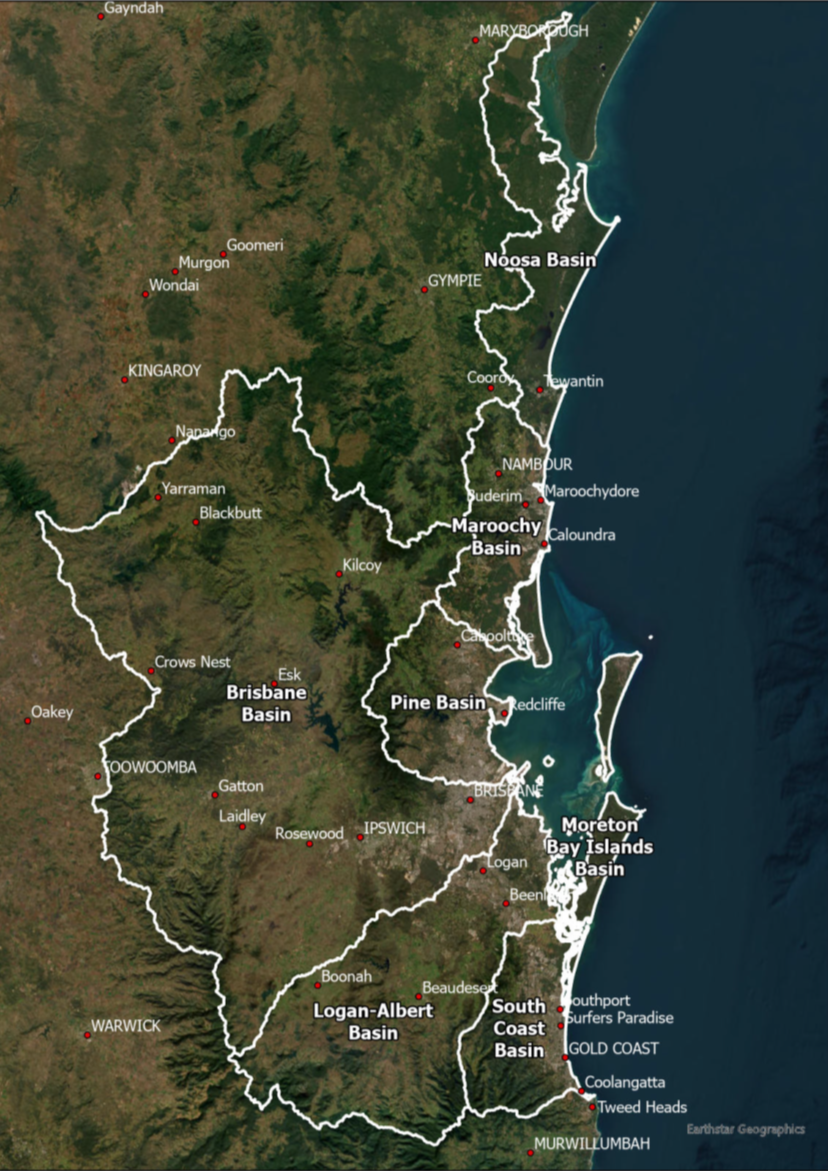
The program works with horticultural growers in catchments across the following basin areas:
Noosa
Maroochy
Pine
Brisbane
Stradbroke Island
Logan-Albert
South Coast
The high concentration of horticultural activity in the Pumicestone, Lockyer, and Bremer catchments make them priority areas for the SEQ Hort BMP Program.
You can see these catchments reflected in the below map.
The Southeast Queensland Region
The SEQ Hort BMP Program operates in the outlined areas with a focus on the Pumicestone, Bremer, and Lockyer catchments.
Learn more about the incentive grants available in the project
-
The Program includes financial assistance in the form of incentive grants, to help address the financial barrier of building capacity and adopting new practices on farm to encourage horticultural growers to adopt Best Management Practices (BMPs) that measurably reduce nutrient, pesticide, and sediment losses from farms and strengthens environmental stewardship.
Incentive grants of up to $30,000 per grower or grower group are available until January 2029 or until fully allocated.
Practices that directly contribute to improved water quality outcomes are supported across the following areas:
Improved soil management (including soil health) i.e. practices that provide ground cover such as multi species cropping and promote soil structure and reduced tillage.
Improved erosion and sediment management practices i.e. ground cover including grassed drains and buffer zones, in field contours, drain stabilisation.
Improved pesticide management (pesticide use efficiency) i.e. targeted scheduling, precision application methods, integrated pest management.
Improved nutrient management (nutrient use efficiency) i.e. targeted scheduling, precision application methods and variable rate application.
Some examples have been provided above, but consult with the SEQ Hort BMP team to discuss what solutions are most appropriate for your farm.
-
The applicant(s) must be a horticultural grower operating in Southeast Queensland (see program map below).
The applicant(s) must align with the program objectives and be seeking support for eligible activities, for example:
on farm practices or activities that are considered best management practices.
on-farm practices or activities that deliver on improved water quality outcomes.
on-farm practices or activities that are NOT deemed ‘business as usual’.
The applicant(s) must commit to BMP benchmarking (Hort360 Water Quality module) at the start and end of engagement.
The applicant(s) must enter into a formal grant agreement with QFVG and provide evidence that funded works were completed.
The applicant(s) must have the capacity to meet the project requirements and within the program timeframes / deadlines.
The applicant(s) must demonstrate a clear commitment to practice change, including broader adoption across the farm where funded improvements are proven successful.
The applicant(s) must share and acknowledge the requirement outcome information to support program reporting on practice change.
All eligibility criteria are mandatory.
Read the full eligibility guidelines.
-
Applying for a SEQ Hort BMP Incentive grant follows a facilitator-guided process, designed to support growers identify the most beneficial on-farm improvements, demonstrate value for money, and verify environmental outcomes:
1. Initial engagement and guidance: contact your local Growcom SEQ Hort BMP facilitator who can assist in assessing your eligibility, identifying potential high-impact BMP improvements, and working through the application requirements.
2. Hort360 water quality risk assessment: to demonstrate that the proposed practice change will have a measurable impact on water quality, applicants must complete a Hort360 baseline assessment to identify risks, gaps, and the most beneficial BMP interventions. This mandatory benchmarking must be completed before applying.
3. Application development: complete the application form in consultation with your SEQ Hort BMP facilitator. Your application must include:
baseline conditions from Hort360 water quality risk assessment
detailed information of proposed practice change/s
expected water quality outcomes
supporting information (e.g., photos, maps, farm data, quotes)
costings and in-kind contributions
implementation plan with timelines and activities.
Submit your completed application to your SEQ Hort BMP facilitator. Your application will be assessed by a panel. You can read more about application assessment below.
4. Notification: The SEQ Hort BMP team will notify you if your application is successful or unsuccessful within one week of the assessment panel meeting. Successful applicants enter into a formal funding agreement with Growcom. Once the agreement is in place, groundworks may commence.
-
Applications for SEQ Hort BMP Incentive funding are assessed by a panel including representatives from the Department of Environment, Tourism, Science and Innovation (DETSI), the Queensland Department of Primary Industries (DPI), and Queensland Fruit & Vegetable Growers (QFVG).
The panel evaluates each application based on its alignment with the following criteria:
Environmental need/risk: the current environmental risk of existing practices, considering proximity to waterways, slope, soil type, erosion risk, runoff pathways, or other relevant site characteristics.
Expected water quality benefit: the potential for the reduction in sediment, nutrient, or pesticides losses; improved soil health; and/or other measurable water quality outcomes.
Value for money: the level of environmental and economic benefits relative to the funding invested, including any in-kind contributions.
Economic and operational benefit to the grower: the likelihood of improving on-farm efficiency, reducing production costs, improving yields and/or quality, or otherwise supporting ongoing business viability.
Extent of practice change: the potential for the proposed activity to represent a meaningful change to farm practices, to be more broadly adopted across the farm, to address multiple issues, or to represent a measurably improved approach from current practices.
Grower and industry benefit: the potential to influence other growers and contribute to wider industry practice change, including willingness to participate in case studies, field visits, knowledge sharing, or other extension activities.
Deliverability and readiness: the likelihood of the proposed activities being completed within the incentive program’s timeframes, with consideration of gathering quotes, contractor availability, approvals, co-contributions, and implementation agreements.
-
Contact the SEQ Hort BMP team using the details at the bottom of this page.
Contact the project team
-

Tim Wolens
SEQ Hort BMP Program Manager
0409 848 076
twolens@qfvg.com.au -

Mabel Smyth
SEQ Hort BMP Program Facilitator
0483 180 862
msmyth@qfvg.com.au

The South East Queensland Horticultural Best Management Practice Project is funded by the Queensland Department of Environment, Tourism, Science and Innovation.